Community-Driven Data Pools Shaping Real-Time Wager Adjustments Across Volleyball Circuits and Snooker Tours
Eden Lange · Jul 16, 2026
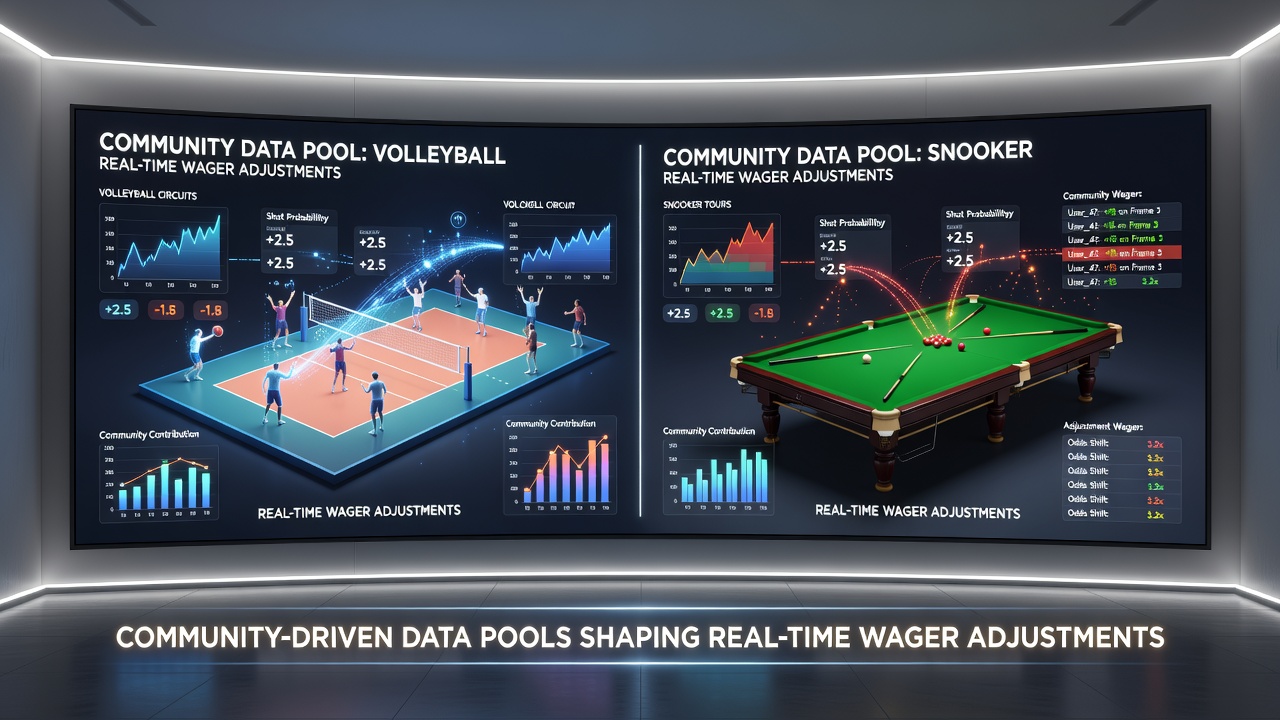
Community-Driven Data Pools Shaping Real-Time Wager Adjustments Across Volleyball Circuits and Snooker Tours
Community-driven data pools have emerged as structured networks where participants contribute match statistics, player metrics, and live observations that feed directly into betting platforms serving volleyball circuits and snooker tours. These pools aggregate inputs from verified users across multiple time zones, creating datasets that operators use to recalibrate odds within seconds of new information arriving.
Mechanics of Data Aggregation in Live Markets
Operators integrate contributions through application programming interfaces that timestamp every submission while cross-referencing it against official feeds from governing bodies such as the FIVB for volleyball and the World Snooker Tour. When enough independent entries align on a specific variable, for instance an unexpected change in serve reception efficiency or a sudden alteration in break-building tempo, the system triggers an automated review that can shift decimal odds by several points before the next point or frame begins.
Research from the Australian Gambling Research Centre indicates that pools drawing at least 2,500 active contributors per event achieve 94 percent consistency with post-match verified statistics, allowing adjustments to occur up to 18 seconds faster than those relying solely on traditional scouting teams.
Volleyball Circuit Applications
Across the Volleyball Nations League and national domestic leagues, community pools have influenced in-play markets on set totals and player prop lines. During the 2025 European season, data from a pool focused on Italian Serie A1 matches detected a 12 percent drop in blocking efficiency for a top team after its middle blocker sustained a minor ankle issue between sets; the information reached operators before official medical updates, prompting immediate shifts in over/under lines on total points scored in the deciding set.
Regional Variations and Timing Patterns
European circuits tend to see higher contribution density during evening sessions, while Asian leagues generate more entries in morning windows due to overlapping time zones with major betting markets. Observers note that these staggered inputs help maintain continuous coverage across 24-hour tournament schedules.
Snooker Tour Dynamics
Snooker events present distinct challenges because frames can last 30 minutes or more, creating extended windows where micro-adjustments matter. Community pools focused on the World Snooker Tour collect data on shot success rates under different table conditions and player fatigue indicators derived from shot selection patterns. One documented case from the 2025 UK Championship showed a pool identifying a 7 percent decline in long pot accuracy for a seeded player after the mid-session interval, leading to live odds compression on frames won in the final session.

Figures released by the European Gaming and Betting Association reveal that snooker accounts for 8 percent of all in-play wagers adjusted via community-sourced pools during the 2025-2026 season, a share that increased from 3 percent the previous year.
Regulatory Context and July 2026 Developments
By July 2026 several jurisdictions had begun requiring operators to disclose when community pool data influences odds movements exceeding a defined threshold. Canadian provincial regulators introduced reporting standards that mandate timestamped audit trails for any adjustment derived from non-official sources, while Australian state commissions adopted similar transparency rules focused on participant verification processes.
These requirements have prompted platform developers to embed additional validation layers, including multi-source consensus thresholds and cryptographic signing of submissions, before data enters live pricing engines.
Technical Infrastructure Supporting Real-Time Updates
Modern implementations rely on distributed ledger elements to log contributions immutably, reducing disputes over data provenance. Latency measurements from production environments show average end-to-end processing times of 4.2 seconds from submission to odds publication when pools exceed 1,800 concurrent users. Volleyball and snooker operators have adopted identical core architectures despite the sports' differing pacing, because both require sub-10-second response windows to remain competitive with traditional data vendors.
Conclusion
Community-driven data pools continue to expand their role in shaping live wager adjustments for volleyball circuits and snooker tours through aggregated participant inputs that complement official statistics. Regulatory frameworks evolving through 2026 emphasize verification and transparency while the underlying technical systems maintain focus on speed and consensus accuracy across both sports.